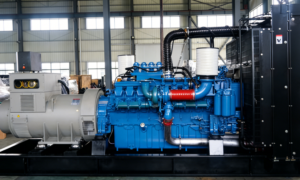

Custom 900kW Diesel Generators – Engineered for Critical Operations

Near the 1MW threshold, a 900kW power plant requires meticulous attention to grid interface, harmonics, and acoustic compliance. We provide the full spectrum of engineering services to navigate these requirements. To discuss your large facility or institutional power project under an NDA, please get in touch with our strategic projects division.

Comparative Analysis: 900kW Diesel Generator Project Factors

Note: Estimated costs are for the complete generator set (Open Type) with a standard high-quality alternator (e.g., Stamford or Marathon). Prices are ex-factory estimates and vary based on configuration and market fluctuations.
BrandEst. Project Cost (USD)Primary Application ScenariosAfter-Sales & Maintenance Analysis
MTU$180,000 - $220,000+Data Centers, Tier-A Hospitals, Semiconductor Plants, High-Tech Labs.Premium: Requires specialized technicians. Longest service intervals. Parts are expensive but highly reliable.
Perkins$150,000 - $190,000Large Infrastructure, Commercial Real Estate, Industrial Manufacturing.Excellent: Global support network. Parts are widely available. High transient response makes it easy to maintain for motor loads.
Cummins$140,000 - $185,000Mining, Oil & Gas, Telecommunications, Remote Construction Sites.Superior: The most accessible parts network globally. "Universal" technology—most senior engineers know how to fix a Cummins.
Weichai (Baudouin)$100,000 - $135,000Heavy Industry, Marine Power, Mining Support, Backup for Large Factories.Robust: Baudouin technology offers European design with localized cost. Very strong support in Asia, Middle East, and CIS regions.
Yuchai$96,000 - $125,000Municipal Projects, Water Treatment, Large Farms, Industrial Standby.High Value: Known for high displacement and durability. Maintenance is straightforward. Fast-growing international service network.
Shangchai$92,000 - $115,000Emergency Standby for Buildings, Small-to-Mid Factories, Seasonal Use.Economical: Lowest initial investment. Best for "Standby" (low annual hours). Parts are extremely affordable and easy to source.

Explanation of Table Content

1. Project Cost Breakdown 

Explain that the “Engine” is only part of the cost. A professional 900kW project includes:

  • Alternator Choice: A genuine Stamford alternator will add 5000-10,000 compared to a local brand but offers better voltage stability.

  • Enclosure: A 20ft Silent Container can add 10000-25,000 to the “Open Type” price.

  • Control
  • Systems: Upgrading to an DeepSea (DSE) or ComAp parallel system for N+1 redundancy adds to the technical cost but significantly reduces downtime risk.

2. Application-Specific Advice 

  • For Data Centers (MTU/Perkins): Focus on “Transient Response.” In a power fail, you need the generator to accept 100% load in one step without a frequency drop that would crash servers.

  • For Mining (Cummins/Yuchai): Focus on “Dust Filtration and Cooling.” These environments require heavy-duty air filters and oversized radiators to prevent overheating in high-ambient temperatures.

  • For Standby Buildings (Shangchai/Weichai): Focus on “ROI.” Since the unit may only run 50 hours a year, the low initial purchase price is more important than 1% better fuel efficiency.

3. After-Sales Analysis 

  • The “Parts Availability” Rule: Before buying a 900kW unit, check if there is a local service center within 200km. A 900kW generator is too heavy to ship for repairs; service must be done on-site.

  • Consumables: Mention that at this power scale, a standard oil change can involve 100+ liters of oil and multiple heavy-duty filters. Brand-name engines (Cummins/Perkins) have “Generic” filter cross-references that can save money in the long run.

4. Typical Maintenance Schedule for 900kW Units

  • Weekly: Visual inspection & battery voltage check.

  • Monthly: “No-load” test run for 15 minutes.

  • Every 250-500 Hours: Change oil, oil filters, and fuel filters (Standard for most brands).

  • Every 1000 Hours: Check valve clearance and cooling system flush.

Technical Comparison: 900kW Diesel Generator Sets (Prime Power)

This table compares representative models from top-tier international brands and leading Chinese brands commonly used for 900kW (approx. 1125kVA) requirements.
Technical ParametersCumminsMTUPerkinsYuchaiWeichai (Baudouin)Shangchai
Engine ModelQST30-G416V2000G16F4008-30TAG3YC12VC1320-D3112M26D110012W1350D
Prime Power (kW)900910900900900900
Standby Power (kW)1000101099099010001000
Cylinders/Arrangement12 / V-Type16 / V-Type8 / In-line12 / V-Type12 / V-Type12 / V-Type
Displacement (L)30.4835.730.5639.631.836.8
AspirationTurbo & AftercooledTurbo & Water-Air IntercooledTurbo & Air-Air Charge CooledTurbo & AftercooledTurbo & AftercooledTurbo & Aftercooled
Fuel Consumption (100% Load)~215 L/h~208 L/h~220 L/h~218 L/h~212 L/h~225 L/h
Governing TypeElectronic (ECU)ADEC (Electronic)ElectronicElectronicECU (Common Rail)Electronic
Oil Capacity (L)154102153140109105
Dimensions (Open Set mm)4800x2050x24504600x1950x23004900x2100x25004700x2150x24004650x2000x23504750x2100x2450

Expert Buying Insights: How to Choose?

1. High-End / Mission Critical Applications (MTU & Cummins)

  • MTU (Germany): Best for data centers and hospitals. It features the best power-to-weight ratio and the most advanced electronic management system (ADEC). High initial cost, but unparalleled reliability and fuel efficiency.

  • Cummins (USA/Joint Venture): The “Global Standard.” If your project is in a remote location (e.g., Africa, SE Asia, or Mining sites), Cummins is the best choice because spare parts and technicians are available in almost every country.

2. Specialized Industrial Performance (Perkins)

  • Perkins (UK): Known for excellent transient response (how fast the engine reacts to a sudden load). Ideal for construction sites with large motors or elevators that start and stop frequently.

3. High ROI & Heavy Duty Industrial (Yuchai, Weichai, Shangchai)

  • Weichai (Baudouin Series): Baudouin is a French brand owned by Weichai. These engines offer European technology with Chinese manufacturing efficiency. They have long overhaul intervals (up to 30,000 hours in some conditions).

  • Yuchai: Very popular in the Chinese and SE Asian markets for 900kW+ ranges due to its massive displacement (39.6L). High displacement usually means the engine is “stressed” less, leading to a longer lifespan under continuous heavy load.

  • Shangchai: The most cost-effective solution for standby power. If you only need the generator for occasional power outages (less than 200 hours a year), Shangchai offers the best Return on Investment (ROI).


Installation & Site Engineering Guide

Installing a 900kW diesel generator is a complex engineering task. At this power scale, the unit typically weighs between 8,000kg and 12,000kg. Proper site preparation is critical to ensure safety, longevity, and peak performance.

1. Civil Work & Foundation Requirements

A 900kW unit generates significant vibration and requires a reinforced concrete foundation.

  • Foundation Thickness: We recommend a concrete pad of 200mm to 300mm thickness.

  • Weight Bearing: The foundation must support 1.5 to 2 times the wet weight of the generator set.

  • Anti-Vibration: High-performance brands like MTU and Cummins require high-precision leveling (less than 5mm deviation) and industrial-grade anti-vibration mounts (usually included in our packages).

2. Ventilation & Airflow Management

A 900kW engine consumes a massive volume of air and generates substantial heat.

  • Intake Air: Ensure the inlet vent area is at least 1.5 times the size of the radiator core.

  • Hot Air Discharge: Use a canvas duct to connect the radiator to the outlet vent to prevent “hot air recirculation,” which is the #1 cause of engine overheating in Perkins and Yuchai high-load operations.

  • Airflow Calculation: For a 900kW unit, typical airflow requirements are approx. 1,200 – 1,500 m³/min.

3. Exhaust System & Backpressure

Excessive exhaust backpressure will reduce power output and increase fuel consumption.

  • Pipe Diameter: For 900kW, we recommend a minimum exhaust pipe diameter of 8 to 10 inches (200-250mm).

  • Bends: Minimize the number of 90-degree elbows. Each elbow adds significant backpressure.

  • Silencers: Industrial-grade or Residential-grade silencers should be installed based on local noise regulations.

4. Fuel System Configuration

At 100% load, a 900kW generator consumes over 200 liters per hour.

  • Daily Fuel Tank: We recommend an external 1,000L to 2,000L double-walled daily fuel tank for 4-8 hours of continuous operation.

  • Fuel Lines: Use black iron or steel pipes. Avoid galvanized pipes as they can react with modern diesel and clog the fuel injectors of high-pressure common rail engines like Weichai or Cummins.

5. Commissioning & Load Bank Testing (The Final Step)

  • Step Load Test: Testing the unit at 25%, 50%, 75%, 100%, and 110% load.

  • Safety Shutdowns: Testing the automatic triggers for Low Oil Pressure, High Water Temperature, and Over-speed.

  • ATS Synchronization: Ensuring the Automatic Transfer Switch switches power within 8-15 seconds during a grid failure.
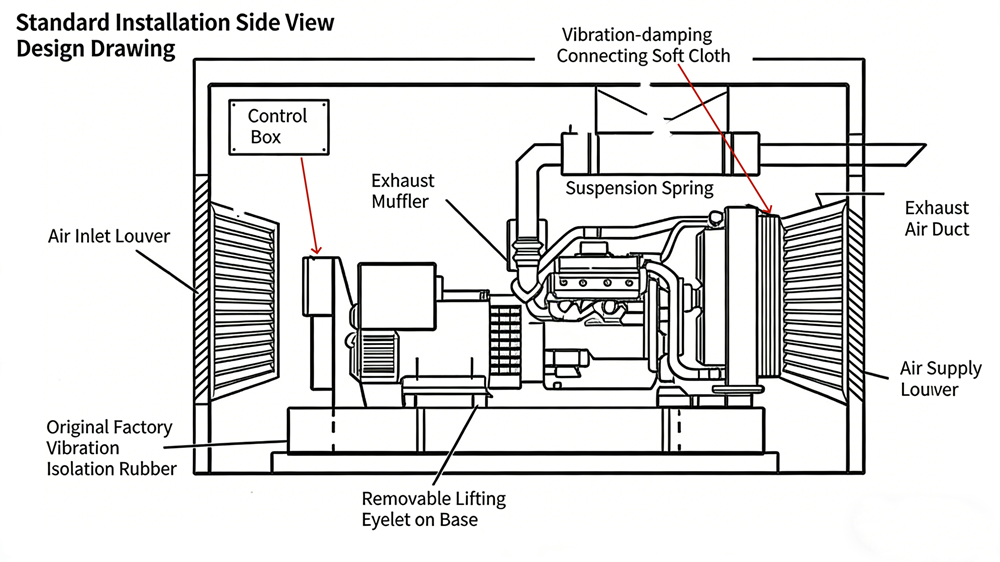
  • Standard Installation Diagram for Diesel Generator Room

Related issues of 900kw diesel generator

What are the key considerations for paralleling multiple 900kW units?

Key considerations include load sharing precision, fault current contribution, and control system architecture. We engineer the complete paralleling solution, including circuit breakers and sync panels, to ensure stable and safe operation.

Can this generator be configured for “black start” capability in an island grid?

Yes, with appropriate battery sizing and control sequencing, these units can be configured for black start, meaning they can start and establish a grid without any external power source, which is vital for standalone power systems.

Do you provide acoustic enclosures meeting specific city noise ordinances?

Yes, we design high-performance acoustic canopies that can achieve noise levels as low as 65 dB(A) at 1 meter to meet strict urban or residential area noise limits, with test reports to prove compliance.

What financial terms are available for large project purchases?

 For qualifying projects and clients, we can work with financing partners to offer structured payment plans, leasing options, or letter of credit (LC) terms to facilitate large capital investments.